
As more teams transition to Five-Out offenses, it is imperative to have skilled bigs. When you do, it’s time to weaponize them by playing through them as the triggerman in offensive actions. In this piece we’ll provide examples of three such actions.
Dribble-At
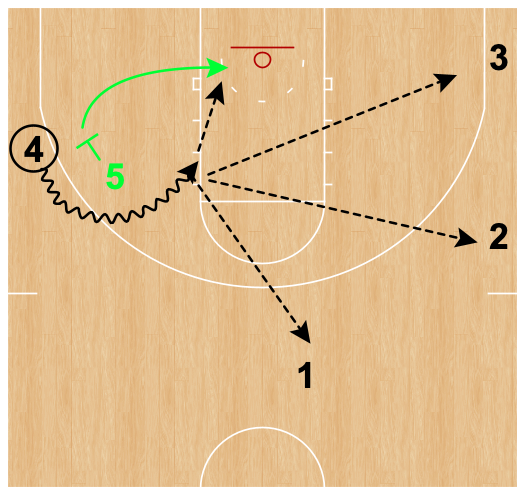
A simple dribble-at with your “5” as the triggerman is easy to get into from a traditional Five-Out alignment.
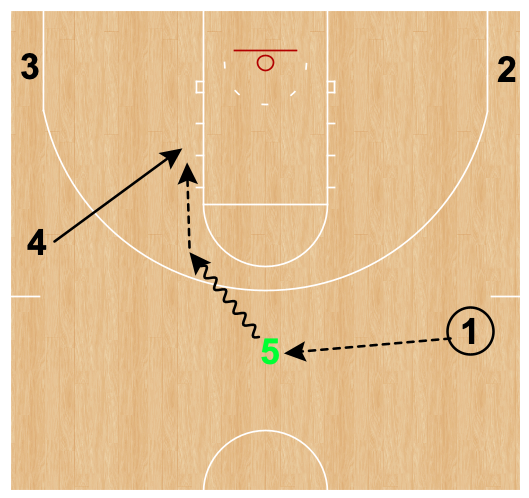
In Fig. 1 above, Player 1 passes to Player 5. Player 5 is now the triggerman.
“If you have the ball, you’re the point guard.”
In a simple dribble-at, Player 5 may dribble back toward the side from whence they got the ball or dribble toward the opposite as shown. Player 5 “punches the gap” with their dribble and Player 4 cuts to the rim. More effective back cuts will emerge when Player 4 waits for one dribble in their direction.
It’s important for Player 5 to keep their dribble. If the backdoor cut is not open, Player 5 keeps their dribble and plays with the next player (See Fig. 2 below).
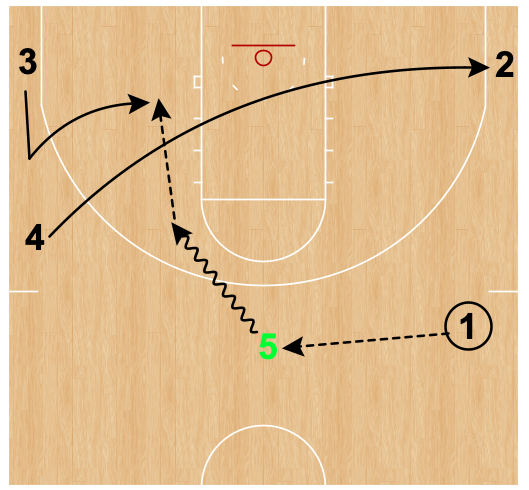
Perhaps Player 3 is denied when coming out of the corner. This results in double backdoor.
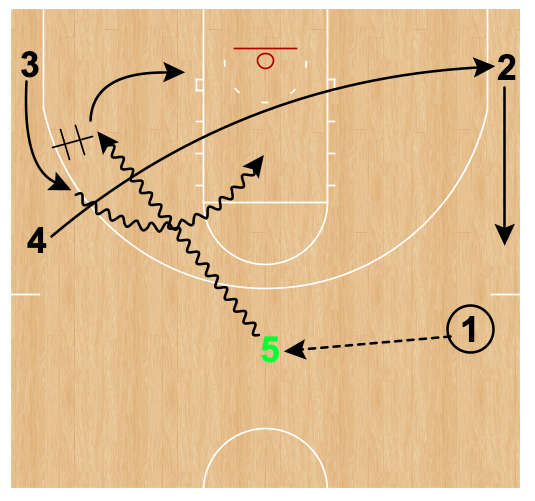
Above, Player 5 keeps their dribble and delivers a dribble handoff (DHO) to Player 3. When delivering the handoff, dribble at the recipient’s defender. Deliver the handoff and try to “get a piece” of their defender.
Below are some “dribble-ats” with the Five-Man as the trigger featuring the Richmond Spiders in the Open Phase of their Princeton Offense.
Corner Splits
Next, another example of playing through the “Five.” Here they are the passer in off-ball split action.
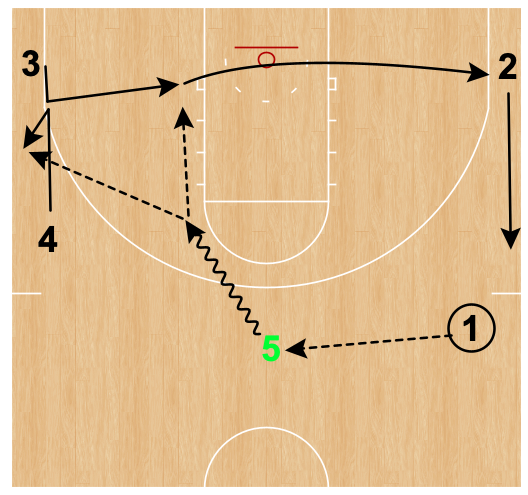
Player 1 passes to Player 5. When 5 turns toward the second side Players 4 and 3 get into a spilt screen. Commonly, Player 3 rejects the screen. When this happens Player 4 pops back. Player 5 may hit the reject cut. If they play to the pop back man, they may chase their pass into a side ball screen as diagrammed in Fig. 5 below.
Below are some examples of this concept from the University of Northern Iowa.
Throw & Go
The last example of playing through the five is the “Throw & Go” handoff. A player, usually a guard, passes to the big (throw) then immediately sprints (go) to take a handoff back from the big (see Fig. 6 below).
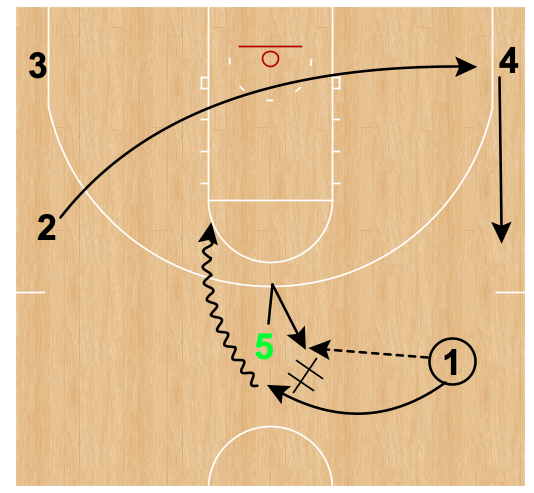
The idea is for Player 1 to “outrun their pass” to gain advantage for penetration when we hand back. Player 5 is the trigger again. They must decide whether the handoff can be delivered cleanly. If the handoff is disrupted (“dirty”) the have the authority to KEEP and GO NEXT – play to the next available player (see Fig. 7 below).
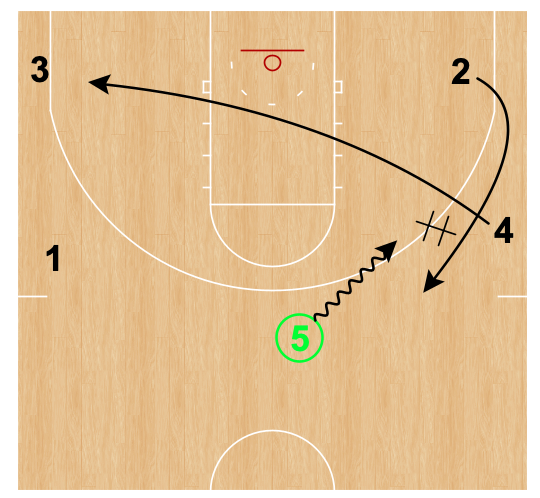
Below are some examples of Throw & Go handoffs from the 2019 Brooklyn Nets.
The Keep and Go Next concept is detailed in this video featuring the 2022 Miami Heat.
https://youtu.be/20GfT-lZrn8
Playing through the Five may require some adjustments to your offense. It may also require an adjustment in mindset for many coaches. For decades, the “five” is associated with camping out on the low block or maybe hiding out in the dunker’s spot. The “five” is thought of more as a play finisher rather than a play initiator. Of course, not all teams are blessed with a “five” who is skilled enough to handle the ball a bit on the perimeter and make handoff decisions like diagrammed above.
However, moving toward a more open and modern attack requires these skills from all players. The benefits to your offense and spacing are obvious if you can bring your big away from the rim, get them facing the basket and playing through them.